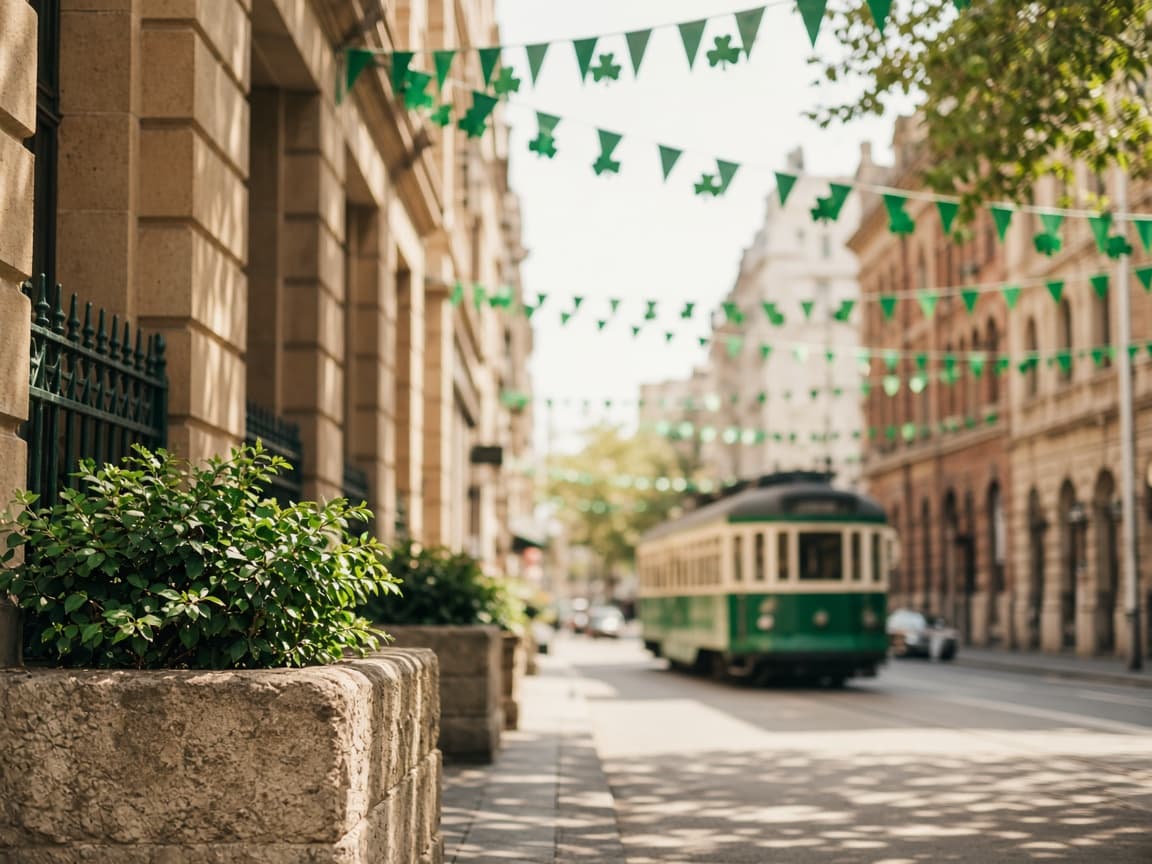
St Patrick's Day in Australia is marked on 17 March with green clothes, music, family meals, parish notes and busy pub rooms. Some cities also hold public parades or concerts on the day or on the nearest weekend. That is the shape of it. The day honours Patrick as a figure of Irish Christian memory and, more loosely, as a badge of Irish belonging. It is a feast. It is not an instruction to drink without limit, and it is not a costume obligatory for anyone who walks down the street.
Australia takes the date in late summer or early autumn, depending on the city. The weather is not Irish March. People stand outside. People walk between rooms. People bring children to a parade in daylight and leave them out of the late bar. Those facts change the tone. A good day here uses the light and the public street as much as the counter.
Who Patrick is, and who the day is for
Patrick is the patron saint associated with the conversion stories of Ireland. The historical figure sits in late antiquity; the cult, the shamrock emblem and the national feast accumulated later. You do not need a parish education to wear green on the day. You also do not need to pretend a theological opinion you do not hold. Plenty of Australians mark 17 March as a cultural date: a reason to meet, to play a tune, to cook a stew, to send a message home.
Irish Australia has long kept the date through churches, societies and sporting clubs as well as through pubs. The National Museum of Australia and diocesan archives record processions and dinners that are older than any current room. A modern city parade, where it happens, sits in that civic line: a public claim that Irish heritage is part of the street. It is not a pub crawl with a permit, even if pubs fill afterwards.
People with no Irish ancestry also come. That is ordinary in Australia. The courtesy is the same as in the rooms: do not mock the faith if you are standing near people who still hold it, and do not demand that a solemn Mass be a party. There is room on the same date for a vigil, a family lunch and a noisy evening. They do not have to be the same event.
What usually happens
Morning can be a Mass, a community breakfast, or nothing more ceremonial than a green shirt on the way to work. Midday, in cities that hold a parade or a civic gathering, is for the street: bands, flags, children, and people who came only to watch. Afternoon drifts toward pubs, clubs and backyards. Evening is music, food and the risk of the day losing its shape.
None of that is a timetable you must copy. If you want a quiet 17 March, you can cook at home, walk, and visit a room early. If you want the civic day, check the city’s own announcements closer to the date rather than trusting a memory of last year. This guide will not invent a line-up, a start time or a named organiser. Those details belong to the people who run them, and they change.
Pub rooms on the day are busy. Expect slower pours, fuller tables and a shorter temper if you arrive in a large unmarked group. Book if the house takes bookings. Arrive earlier than you think. Eat. Decide the last drink before the last drink decides you.
Green, emblems and taste
Green is the easy emblem. A shamrock, a harp and a tricolour appear on shirts, cakes and windows. There is a line between marking the day and wearing a joke at the expense of the people the day remembers. Plastic hats and fake ginger beards sit on the wrong side of that line for many rooms, especially rooms that still feel the date as theirs. You do not need a lecture to see it. If an item would be rude at a family lunch, it is rude on the street.
Religious medals and parish badges are not costumes. If you do not share the faith, you do not need to wear them, and you should not borrow them as decoration.
Music on the day ranges from a session in a corner to a stage on a street. The sessions guide still applies. A parade band is a performance; a pub circle is not. Clap in the right place. Do not start a song over someone else’s set because you know one chorus.
Food on the day
People cook and order the same plates the rest of the year: stew, soda bread, a fry, bacon and cabbage. Some houses put a themed board on. That can be a pleasure if the kitchen already knows the food. It can be a disappointment if the board is only dyed and sweet. The food and drink guide is the better place for the plates themselves. On 17 March the useful advice is simpler: eat before you drink, and treat dessert as optional rather than as another round.
Tea remains a civilised drink on a feast day. So does water. A house that will not pour either is not keeping a feast. It is keeping a queue.
Drinking on a feast day
The legal age is still 18. The Australian guidelines from the National Health and Medical Research Council still apply. DrinkWise Australia still advises moderation in language anyone can use. A feast day is a known risk for people who already drink more than they mean to. If that is you, set a number, appoint a friend, or stay out of the rooms that only sell the blur.
Do not drive. Late summer evenings in Australian cities are full of people who thought they were fine. Plan a train, a tram, a taxi, a designated driver who is actually not drinking. If you are hosting at home, put food out first and stop pouring when you said you would.
If you are with teenagers, keep them out of the bar and give them a version of the day that is about music, food and family. The date will still be there when they are eighteen.
Work, school and the weekday problem
17 March is not a national public holiday in Australia. It can fall on a Tuesday. People still have shifts, school pick-ups and early trains. That is why some civic events sit on a weekend nearby. It is also why a good room will feed people at lunch and not only at midnight. If you are taking the afternoon, say so at work in the ordinary way. Do not treat the saint as a sick note.
For people in hospitality the day is work. Be kinder than the volume around you. Orders will be slower. Glasses will take longer to come back. A feast that abuses the people serving it has failed.
A civic date, not a venue calendar
This site will not tell you that a particular street is “the place to be” and it will not publish a list of official after-parties. Those lists become advertising and they go stale. If you want a parade, look to the city or the Irish community organisations that have announced one. If you want a Mass, look to the parish. If you want a quiet pint, go early to a room you already know, or to a dining room that still has a table.
Functions on or near the date need more lead time than a normal Thursday. Say that it is 17 March when you enquire. Ask about last orders, about whether the room is open to the public as well, and about a finish time that respects neighbours. A private gathering can still be a feast. It should not become a second parade in a laneway.
Visitors and the rest of the year
If you are visiting an Australian city only for the date, treat the civic programme as optional and the room as ordinary. A parade is a bonus when a city has announced one; it is not owed to you. A pub that is kind on an ordinary Tuesday is a better souvenir than a photograph of a crowded March pavement. Ask for a stew and a careful pint. Leave before the night becomes only volume.
People who live here can use the date as a yearly reminder to support music, to cook for someone, or to write to family. That habit outlasts any one street party. If you host at home, the same rules as a pub function apply: food first, water on the table, a finish time, and a way home that does not involve a car key.
After the day
18 March is an ordinary date. The useful habit is to drink water, to eat, and to leave the plastic things in the bin. If you enjoyed a room, you can go back when it is quiet and see whether the welcome holds. That is a better test of an Irish pub than any March photograph.
If the day left you with a question about the rooms themselves, the Irish pubs guide is the longer cultural answer. If it left you with a question about a pour or a plate, use the food guide. Keep Patrick as a reason to meet, not as a reason to disappear from yourself.